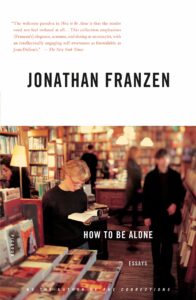
How to Be Alone: Essays
by Jonathan Franzen
first published 2002.10.01
started 2026.03.08
finished 2026.05.01
medium: used paperback purchased from Half Price Books that is really gross and kind of falling apart
I read a more recent collection of Jonathan Franzen’s essays a year ago: The End of the End of the Earth. That book focused on the environment and nature, and the ways humans do and should exist in the world. Also, lots of birds. He’s really into birds, apparently.
“The End of the End of the Earth” was published in 2018; How to Be Alone in 2002. The latter has a broader focus: each essay is its own, distinct topic (though with some overlap, as one may expect), from his father’s Alzheimer’s and death, to the United States Postal Service, to federal prisons. The essays in the book have been previously published in other places, such as The New Yorker and Harper’s Magazine.
The “being alone” aspect is an interesting idea because his essays seem to center around his role in our social fabric. His mental health comes up in some of the essays, which I enjoyed.
The most immediately striking thing about Franzen is his writing style. He’s a postmodern, maximalist writer, according to my English teacher, and his sentences are often very dense and complex, which is very fun to read, albeit sometimes exhausting. English teacher also compared his writing to David Foster Wallace, who I have not yet read.
Some sentences I liked:
- “The truth is that without firm parental guidance teenagers make all sorts of irrevocable decisions before they’re old enough to appreciate the consequences—they drop out of school, they get pregnant, they major in sociology.”
- “… the deforming influence of legal counsel on the actions of the industry.”
Those are the only ones I got because I forgot to take notes after the second one.
Franzen also covers so, so much in most of these essays that it would be impossible for me to cover everything that I find interesting. So even if I seem to overcontextualize by way of summarizing and quoting, there are plenty of Franzen words I’m leaving untouched, which warrant further investigation by you.
Below, I have written, in order, about each of the 15 essays in the book. (The 2002 hardcover edition has 14 essays; the 2003 trade paperback, which I have, has 15 after the addition of “Mr. Difficult” (and modifications to “Scavenging”).
Due to the general decline of my well-being over the past few months, the reflections start of strong and gradually get worse. I’m just exhausted all the time, physically and emotionally, and have perpetual sources of stress. Attempts to use reading and writing to remediate those feelings have not worked very well, as you’ll be able to tell. I recently wrote a speech to give at my high school graduation, and it’s cynical, fatalistic, and borderline depressing. Sorry.
My Father’s Brain
Originally published in The New Yorker
What a strong start to this book. “My Father’s Brain” is about Franzen’s father, who had Alzheimers late in his life before he passed away. This piece works really well because of its breadth. Franzen covers his own memories of his father. He talks about death’s timeframes: how long before his actual death was Franzen’s father already dead to the world? And was that transition gradual, or a sudden binary? He also includes the medicine and science behind his father’s condition.
He invokes the idea of memory—excerpts of letters from his mom, and a few from his dad—how do we remember some events so vividly, while others are mere vaguery? He writes, “In relying on my mother’s letters to reconstruct my father’s disintegration, I feel the shadow of the undocumented years after 1992, when she and I talked on the phone at greater length and ceased to write all but the briefest notes.” And those phone conversations are effectively nonexistent, now, whereas the written letters continue to exist as documentation.
Another topic he covered was the idea of labels and diagnoses. “I remember my suspicion and annoyance,” Franzen writes, “fifteen years ago, when the term ‘Alzheimer’s disease’ was first achieving currency. It seemed to me another instance of the medicalization of human experience, the latest entry in the ever-expanding nomenclature of victimhood.”
He grapples with labeling his father’s condition while acknowledging his humanity, and of course, slowly losing a family member.
Franzen writes about his father’s passing in such an analytical way that it’s almost distant, yet the very little I know of Franzen, this is exactly how he would go about processing his father’s death. He thoroughly acknowledges each aspect of the situations surrounding the death, and gives space and time, in the form of words, for his feelings and reflections to exist.
My favorite part of the essay was written by Franzen’s dad, in the one letter written to Franzen from him that is quoted in the essay. Franzen’s father wrote:
And then there is the problem of gifts for your mother. She is so sentimental that it hurts me not to get her something nice, but she has access to my checking account with no restrictions. I have told her to buy something nice for herself, and say it is from me, so she can compete with the after-Christmas comment: “See what I got from my husband!” But she won’t participate in that fraud. So I suffer through the season.
Imperial Bedroom
Originally published in The New Yorker
This one felt weak to me. He criticizes the “recent” privacy craze, where the mainstream is hyper-fixated on the protection of individual privacy. Franzen pushes back. He begins the essay: “Privacy, privacy, the new American obsession: espoused as the most fundamental of rights, marketed as the most desirable of commodities, and pronounced dead twice a week.”
Later he continues, “Privacy proves to be the Cheshire cat of values: not much substance, but a very winning smile.” The concept of privacy is a mess, legally: “no criminal statue forbids it in the abstract,” he writes, only specific violating actions such as stalking and rape. He discusses the illusion of privacy being the only necessary part of it in some contexts, like “talking to a friend on the phone.” Americans sacrifice privacy on the daily, he argues, for “tangible gains in health or safety or efficiency” such as in the cases of healthcare and law enforcement.
Franzen isn’t against privacy in practice or as a concept, I don’t think; rather, he’s against the fatalistic tunnel vision he thinks people typically view the issue with. The thread that Franzen uses to sew his argument together is Kenneth Starr’s investigation on inappropriate actions between president Bill Clinton and a White House intern, which led Congress to impeach him. When the report came out, Franzen writes, “my privacy was, in the classic liberal view, absolute.” He was home alone. “Yet the report’s mere existence so offended my sense of privacy” that he couldn’t even touch the crossword he intended to do.
The bulk of his argument is that no, the so-called “private sphere” isn’t under attack; instead, the “public sphere” is:” If privacy depends upon an expectation of invisibility, the expectation of visibility is what defines a public space. My ‘sense of privacy’ functions to keep the public out of the private and to keep the private out of the public.”
He gives us a vivid example: “I walk past a man taking a leak on a sidewalk in broad daylight, … and although the man with the yawning fly is ostensibly the one whose privacy is compromised by the leak, I’m the one who feels the infringement.”
This is similar to an argument about the loneliness epidemic that says social media blurs the line between social and private settings. Social media invites everyone—friends and strangers alike—into the home, and it also allows one to isolate themselves when in a public, social setting. This fine line that used to exist, separating the private from the public, is now blurred beyond recognition, making people feel lonelier, because social expectations are first thwarted then redefined.
Of all the essays in this book, I think this one suffers the most from the two-and-a-half decades of aging. Social media and other new medias have dramatically changed the landscape of data protection, advertising, and bureaucratic efficiencies. I wonder if Franzen still stands by his argument here, or if he would revise it to better reflect the last 25 years. I don’t know that I agree with a lot of his generalizations. But I do think his arguments can be evaluated under different, newer contexts, where they often can ring true.
Why Bother?
Originally published in Harper’s Magazine
This essay blew me away, and I’m sure I didn’t fully understand it. It was originally published in Harper’s Magazine with the title “Perchance to Dream,” a Hamlet reference. He renamed it “Why Bother?” for this book. Apparently this is one of Franzen’s most famous, and also controversial, essays.
He wrote it before his third novel, “The Corrections,” was published. (I have not read it yet, but I have this book. and have no clue where it came from—”The Corrections” and “The End of the End of the Earth” are two Franzen books that appeared in my room without any memory of how.) He writes about a perceived “despair about the American novel.” Basically, he says that novels now matter a lot less to the “American mainstream than they did when Catch-22 was published” in 1961. (Franzen’s essay is dated 1996.) He complains about a general decline of culture: “The dollar is now the yardstick of cultural authority, and an organ like Time (magazine), which not long ago aspired to shape the national taste, now serves mainly to reflect it.”
He says that this exacerbates the issue of the book as a medium.
There’s never been much love lost between literature and the marketplace. The consumer economy loves a product that sells at a premium, wears out quickly, or is susceptible to regular improvement, and offers with each improvement some marginal gain in usefulness. To an economy like this, news that stays news is not merely an inferior product; it’s an antithetical product. A classic work of literature is inexpensive, infinitely reusable, and, worst of all, unimprovable.
He also says that societal change has picked up its pace enough that “the writer who wants to tell a story about society that’s true not just in 1996 but in 1997 as well can find herself at a loss for solid cultural referents.” I disagree. I think there are several universal and timeless, at least on a small timescale of like a century, elements to society that novelists can and do pursue in their works. There’s a reason there is so much classic literature still being read today. I think Franzen’s view here is dramatically and falsely narrow.
This essay is great, though, because Franzen weaves together all sorts of things that seem, at first glance, not quite relevant to each other, yet he masterfully convinces us that each, seemingly disjoint aspect of his life is all connected. He goes from the economics of books to his general depression (written about in the past tense). Pages 72-73 of the book were incredible to me; Franzen grapples with “depressive realism” and how he’s expected to convey his experience through his writing. “You are, after all, just protoplasm,” he writes, “and some day you’ll be dead.”
But all the available evidence suggests that you have become a person who’s impossible to live with and no fun to talk to. And you increasingly feel, as a novelist, that you are one of the last remaining repositories of depressive realism and of the radical critique of the therapeutic society that it represents, the burden of news-bringing that is placed on your art becomes overwhelming.
Franzen is asking, should he write his novel to express the things he wants to express, or sacrifice that to fulfill some obligation to write a novel that will feel relevant to the modern reader?
In the introduction to “How to Be Alone,” Franzen laments that his interviewers consistently didn’t understand the thesis of this essay. They’d ask him if “The Corrections” kept his promise that it should be a “big social novel that would engage with mainstream culture and rejuvenate American literature,” and he’d respond that no, that’s actually the exact opposite of what I meant. Franzen just wanted to write what he wanted to write—he wanted to stay true to his “sense of social responsibility as a novelist and learning to write fiction for the fun and entertainment of it”—and this essay was his exploration of how the book fits into our new and changing culture. “I was puzzled,” he writes, “and more than a little aggrieved, that nobody seemed able to discern this simple, clear idea in the text. How willfully stupid, I thought, these media people were!”
But then he admits that when he revisited the essay for this book, “I found an essay, evidently written by me, that began with a five-thousand word complaint of such painful stridency and tenuous logic that even I couldn’t quite follow it. In the five years since I’d written the essay, I’d managed to forget that I used to be a very angry and theory-minded person.”
My favorite idea in this essay was the section with Shirley Brice Heath, a linguistic anthropologist and English professor at Stanford University. She told Franzen about her research into who reads books. A crude summary, by me, is that there are two reasons people become habitual readers: either a person’s parents modeled the habit from a young age, and they picked it up, or they were “social isolates” who didn’t have friends and could only relate to authors of books. Interestingly, she said that these isolates were also more likely to become writers. Franzen writes:
If writing was the medium of communication within the community of childhood, it makes sense that when writers grow up they continue to find writing vital to their sense of connectedness. What’s perceived as the antisocial nature of “substantive” authors, whether it’s James Joyce’s exile or J. D. Salinger’s reclusion, derives in large part from the social isolation that’s necessary for inhabiting an imagined world.
This essay will interest anyone who reads, writes, engages in any kind of culture, or sometime struggles to find their place in the world. Franzen writes, “Once I stepped outside my bubble of despair I found that almost everyone I met shared many of my fears, and that other writers shared all of them.”
He later says, “Readers and writers are united in their need for solitude, in their pursuing of substance in a time of ever-increasing evanescence: in their reach upward, via print, for a way out of loneliness.”
The bleak forecast of his essay somehow ends on a somewhat hopeful note, that reading, and therefore writing, is likely here to stay.
I have stolen the title of this essay to be the title of my high school graduation speech, which I will deliver at the end of May.
Lost in the Mail
Originally published in The New Yorker
Franzen isn’t one to boast about his journalistic techniques, but this essay has sources galore. It’s about the Chicago post office shutdown in 1966, and its parallels to events of failure in the 90s. While, according to Franzen, “The Postal Service, though forever maligned, is the most constant and best-loved presence of federal government in the nation’s daily life,” he describes lost mail in Chicago due to extreme cold, mail carrier inefficiencies, mail carrier dishonesties, poor management, and poor bureaucratic organization and reorganization.
He interviewed managers (“Most people say we’re overpaid and do nothing,” one said), mail carriers (“It doesn’t take a hell of a lot of brains to do this job”), and Chicago residents, in addition to his expectedly thorough research on the topic. The most interesting subject was Gayle Campbell, a manager whose entire life became her work, and worked hard for reform and change: “A ‘dirty’ post office offended her like a dirty bathroom,” Franzen writes about Campbell.
Franzen also mentions the financial aspect of the USPS. “The Postal Service’s hopes of survival are pinned on growth,” he writes. The essay was written in 1994; more than three decades ago. The USPS continues to struggle financially—according to a U.S. Government Accountability Office report, the USPS has lost money every fiscal year between 2007 and 2025 other than one, accumulating $118 billion in net losses in that time.
While this essay certainly wasn’t Franzen’s most enlightening piece of writing, I read every word of this piece with intrigue; I, too, admire the United States Postal Service, and learning of its various workings and historical failures was interesting.
Erika Imports
This one is short—barely four pages. It’s about a job he had in high school, working for a German couple who operated a small importing business in their basement. He’s basically just complaining about that job, about how he even envied his friends who got paid less at fast food restaurants because he didn’t like the job.
His chief complaint about the gig revolved around, again, privacy: “The main reason I envied my friends in the fast-food kitchens, though, was that their work seemed to me so wonderfully impersonal. They never had to see their supervisor’s blue-veined stomach,” etc. He also didn’t like that his mother felt bad for them, and after high school, always wanted him to pay the couple a visit.
We get it, Mr. Franzen. You like personal space, and don’t like getting in other people’s personal and uncomfortable business.
Sifting the Ashes
Originally published in The New Yorker
This one begins, “Cigarettes are the last thing in the world I want to think about.” Then he thinks about smoking for 20 pages.
Basically, Franzen doesn’t consider himself a smoker but he smoked, and quit, then smoked again then quit again. This one wasn’t particularly interesting to me. The one particularly fascinating thing was the idea that cigarette smoking is beneficial to the U.S. economy—Franzen quotes someone who says it should be subsidized rather than taxed based on the fact that smoking saves costs such as Social Security, private pension funds, and other savings from people dying sooner. I wonder if that’s changed in the last few decades.
The Reader in Exile
Originally published in The New Yorker
This book is similar to Why Bother? in that he laments the state of postmodern literature. He quotes Nicholas Negroponte, who took a highly optimistic view about the future, a world that embraces all new technologies.
Artificial Intelligence has made the reading of this essay so different from anything Franzen, I suppose, could’ve imagined. But maybe Negroponte saw it coming. (He’s still alive, so I could look up his current work if I felt like it, assuming he still writes.)
This was a good sequel to Why Bother?.
First City
I don’t feel like writing about this one. He loves New York City, because he hates it. Or he hates New York City because he loves it. Or something.
I want to live in a city.
Scavenging
I enjoyed this one! It’s about anachronistic (thanks Emilia Carmona for teaching me that word) technology in Franzen’s home: telephone, radio, whatever else. As someone who has a flip phone, takes photos on film, and desperately wants a manual typewriter, I can definitely understand the romance of resisting technological upgrades.
As it was written in 1996, his examples are: recording tapes of CD-only album releases, a rotary telephone from AT&T, and some other stuff I don’t really remember because it’s been a while since I read this and why don’t you just read it yourself.
I prefer the reproachful heaviness of my rotary, just as I prefer the seventies clunkiness of my stereo components for the insult it delivers to the regiments of tasteful black boxes billeted in every house across the land.
The version of this essay in the paperback version of the book I read has an edited version of “Scavenging.” I found the original piece published in The Antioch Review, and it’s interesting to note the differences. I’m guessing Franzen made the edits himself, but I do wonder how much was publisher/editor intervention.
One theme of the piece is anachronistic technology as a form of resistance. Or, to use an adjective added in the book version but not in the original piece: “aesthetic” resistance.
“At the root of both of my reasons for keeping the rotary is a fiction-writer’s life,” he writes. As he reckons with his desire to keep in service older technology, he struggles with feeling left behind or left out of social change: “One day the victim of the market turns out to be not a trivial thing, like a rotary phone or a vinyl disc, but a thing of life-and-death importance to me, like the literary novel.” Here we are again.
The pain of consciousness, the pain of knowing, grows apace with the information we have about the degradation of our planet and the insufficiency of our political system and the incivility of our society and the insolvency of our treasury and the injustice in the one-fifth of our country and four-fifths of our world that isn’t rich like us. Given this increasing pain, it’s understandable that a large and growing segment of the population should take comfort in the powerful narcotics that technology offers. The more popular these narcotics become, the more socially acceptable their use—and the lonelier the tiny core of people who are temperamentally incapable of deluding themselves that the “culture” of technology is anything but a malignant drug. It becomes a torture each time you see a friend stop reading books, and each time you read of another cheerful young writer doing TV in book form. You become depressed.
But then he goes on to say something I disagree with, which may be a change of the last few decades: “And then,” he writes,
you see what technology can do for those who become depressed. It can make them undepressed. It can bring them health. And this is the moment at which I find myself: I look around and see absolutely everyone (or so it seems) finding health.
He cites television and Prozac as examples.
Clearly, he wrote this before social media was invented; before our country saw meteoric rises in suicide rates and mental health issues correlating with the rise of smartphones and virtual social “connection.”
Something interesting happens in the writing right after that paragraph. There’s a break, then: “So ends the fragment of essay that I’ve scavenged in assembling this one. I wrote the fragment two years ago when I was alone and unable to write fiction—unable, almost, to read a newspaper, the stories depressed me so much. …
Who knows if I can generalize from my own experience. All I know is that, soon after I wrote that fragment, I gave up. Just plain gave up. No matter what it cost me, I didn’t want to be unhappy anymore. And so I stopped trying to be a writer-with-a-capital-W. Just to desire to get up in the morning was all I asked.
Control Units
I didn’t like this one. He talks about the Federal Correctional Complex in Florence, Colorado. The town welcomed the building of the prison for promised economic benefits that were never realized. It was kind of boring.
Only in the last two pages does he say anything interesting. Only then does he talk about fascism and the institution of prison.
Mr. Difficult
Originally published in The New Yorker
Holy cow this one starts really strong. Franzen is confronted by the classism of literature, including his own writing. He received angry mail from a stranger who complained about some things he said in interviews. He replied, suggesting she actually read the novel instead of relying on “distorted news reports about its author.” This stranger did, and called him a “pompous snob, and a real ass-hole.”
This then calls into question the purpose of a novel, and how it relates to art generally. Franzen apparently “subscribe[s] to two wildly different models of how fiction relates to its audience.” The first, the Status model (Flaubert’s), sees the best novels as great works of art and their authors deserve extra recognition. The second, opposite Contract model says that “a novel deserves a reader’s attention only as long as the author sustains the reader’s trust.”
To an adherent of Contract, the Status crowd looks like an arrogant connoisseurial elite. To a true believer in Status, on the other hand, Contract is a recipe for pandering, aesthetic compromise, and a babel of competing literary subcommunities.
The argument for the Status model is that “simple,” conventional fiction may not be adequate for conveying complex, uniquely modern social crises that authors often feel. The argument for the Contract model is greater accessibility, I guess. I don’t know which one I would side with.
Franzen then focuses on author William Gaddis; first his book The Recognitions and then J R. The first book is nearly 1,000 pages and inspired the title of Franzen’s third novel: The Corrections. Franzen related to the main character but didn’t realize he related to him when he first read it, blah blah blah. He says that Gaddis was “very angry—so angry that, at a certain point, he stopped making sense.” (Later he calls Gaddis constipated: “constipated to the point of being unreadable.”)
He brings Gaddis up, I would venture, because of the idea of reading hard-to-read books. Gaddis’s books, at least according to Franzen, are difficult. (“I was halfway through J R when I bailed out,” he writes. “Even then, though, his anger made me wonder: had he betrayed me, or had I betrayed him?” The reader-author relationship is a very interesting aspect of literature.)
“One pretty good definition of college,” Franzen says, “is that it’s a place where people are made to read difficult books.” I graduate from high school this month, and as I figure out what the hell I’m doing with the rest of my life, this supposed purpose of college is interesting to think about. One school I applied to but don’t plan on attending is St. John’s College, a tiny liberal arts school. On its two campuses—one in Annapolis, Maryland and another in Santa Fe, New Mexico—all students follow the same curriculum of reading. The college calls itself a “Great Books School.” Students read Homer and Euclid and Eliot and a bunch of other white European dudes and participate in seminars with tutors—what it calls its professors.
St. John’s seems like the most literal example of what Franzen is describing when he generalizes higher education. And for Franzen, who graduated from Swarthmore College with a B.A. in German, “Four years of sophistication had a cumulative effect,” he wrote.
As a freshman, I thought it would be cool to make up stories for a living, to have that be my job, to see my name in print. By the time I was a senior, my ambition was to create literary Art.
He thought that this capital-A Art “resisted casual reading” and “merited sustained study.” His parents disagreed.
I enjoy this kind of thought, looking at the purpose of a medium. The questions Franzen asks about writing and modern literature can be asked of most anything I might do with the rest of my life: journalism, advocacy, politics, and yeah, literature. I have no clue what I want to study in the fall. I’ve put down public policy, but I plan to take journalism classes at least, if not double major in it. I could also study philosophy or literature or get a teaching license. I think to me, fulfillment is realized in making a positive impact, which can exist in a career that comes from any of those fields of study. But exactly what positive impact means—who I’m impacting and how—I definitely don’t know, and may spend the rest of my life figuring out.
Franzen does this thing where he brilliantly connects a piece of literature or some other non-personal thing with his own life and inner monologue. That kind of parallel communication tends to be very strong, because it is engaging and easy for a reader to grasp. The best political commentaries work that way: a mentor journalist told me recently he was pondering writing a column comparing Bloomington, Indiana’s use of Flock license-plate reader data and some other internal-to-city-government database, which would be an excellent way to explain the latter to a reader who is even vaguely familiar with the conversation around the Flock cameras.
Franzen’s discussion of Gaddis morphs into him shitting on the author, then he’s like “hey look now I sound like that stranger who shat on me!” Despite its lack of personal relevance to me, this was my favorite essay.
Books in Bed
These essays consist mostly of Franzen writing words about someone else’s words. (And here I am writing words about his words about words.) The words in question are discussions of sex, both directly (books about sex) and indirectly (novels that contain sexual scenes).
Meet Me in St. Louis
This was a masterpiece in revisiting past memories. Franzen is asked by a camera crew to visit his childhood neighborhood in St. Louis, where he grew up. He refuses to be filmed inside or in front of his old house, even though the new owners are happy to let him in, and he is pained even to look at the house. He hates existing in a place where so many positive memories were created, ones with people who are no longer alive and with events that will never again take place.
I believed that the reason I couldn’t stand to look at my old house was that I was done with it: that I didn’t want to feel the inevitable nothing when I went inside it. I didn’t want to have to blame an innocent house for still existing after its meaning had been emptied out.
That’s the end of a paragraph about this sadness he feels; the next section begins with a sentence that made me kind of laugh: “But the show must go on!”
As a young person about to graduate high school and forced to confront a future that is still merely conceptual, Franzen’s reflections on his childhood home, memories, loss and death fill me with comfort in knowing that this is to be expected. I am experiencing loss of family every day. I have to make a decision about what college to go to today—how far I’ll be from home, how much money it’ll cost, who will pay for it. How often will I be home, when will it be too late, and when will I regret the things I’ve said and done.
When will I be the author on television, asked to revisit my former life? And will I revisit it with sorrow or joy? Regret or gratefulness? Why am I presenting these as binaries?
This essay feels especially depressed and as though Franzen is particularly disassociated with the world; yet his feelings are profoundly articulated and painfully delivered.
Or maybe he’s just dramatic.
Inauguration Day, January 2001
I didn’t feel like reading this one.